
Julia Gidney
Jul 15

Bullying and Harassment Training for Barristers: A Chambers Guide to the Harman Review Requirements

The Bar has a bullying and harassment problem and the regulators have said so in plain terms. Baroness Harman's independent review found 44% of barristers had experienced or witnessed bullying, harassment or discrimination in the previous two years, up from 38% in 2021 and 31% in 2017. Off the back of this finding, chambers now face a clear expectation: put proper, role-specific bullying and harassment training for all barristers in place and be ready to show evidence of doing so.

This guide sets out what the Harman Review changed, what the Bar Standards Board (BSB) and Bar Council now expect and what chambers should look for when choosing a training programme. Written for chambers’ CEOs and practice managers, barristers and pupils, the guide draws on the published Review, current BSB guidance, the Bar Council Toolkit for chambers and the Commissioner for Conduct’s protocols with the BSB and with the judiciary

What is the Harman Review?

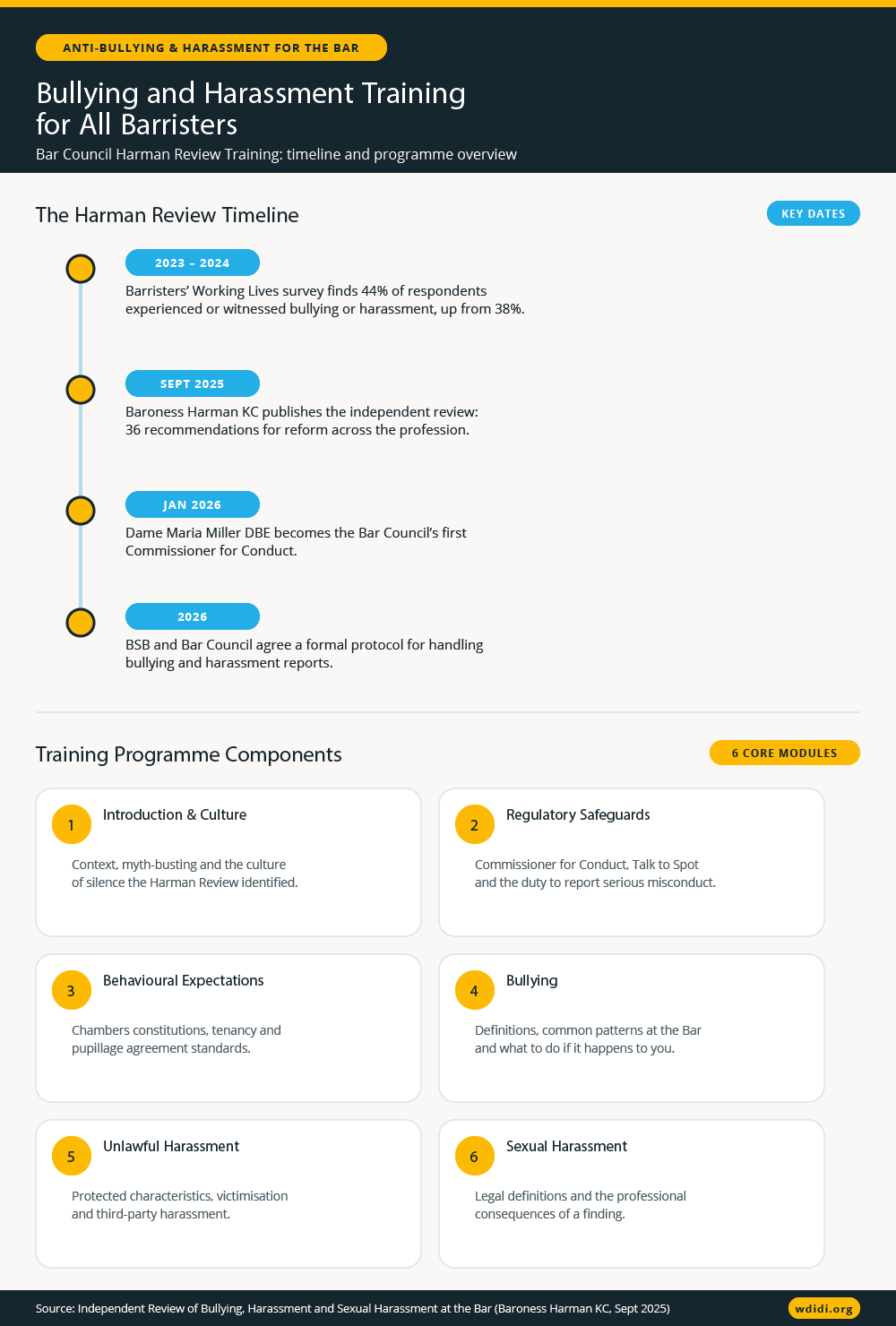
The Harman Review is the independent review of bullying, harassment and sexual harassment at the Bar, chaired by Baroness Harriet Harman KC and commissioned by the Bar Council. Published in September 2025, the report sets out 36 recommendations for the profession, built on more than 170 written submissions, visits to every circuit and meetings with pupils, junior and senior barristers, chambers staff and members of the judiciary.
Baroness Harman described the underlying problem as a culture of impunity, where senior figures who commit misconduct face little consequence and those affected carry all the risk in speaking up. Barbara Mills KC, then Chair of the Bar Council, called the findings uncomfortable reading and a once-in-a-generation chance to change the culture of the profession.

Central recommendations include mandatory, consistent anti-bullying and anti-harassment standards and training across the profession, a new Commissioner for Conduct and an overhaul of the complaints system. Dame Maria Miller DBE took up the Commissioner for Conduct role in January 2026 and a formal protocol between the Bar Council and the BSB governing how reports are handled followed shortly after, with a similar protocol with the judiciary following that.

What counts as bullying and harassment at the bar?

Chambers asking staff and members to complete training need shared definitions before training starts.
Bullying had no fixed legal definition but the Acas definition has now been adopted, describing repeated, unreasonable behaviour from a person or group that is either offensive, intimidating, malicious or insulting or an abuse or misuse of power that undermines, humiliates, or causes physical or emotional harm to someone. At the Bar, this shows up in patterns such as public criticism in front of clients, deliberately excluding a pupil from work, or persistent unreasonable demands tied to seniority.

Harassment does have a legal definition. Under section 26 of the Equality Act 2010, harassment means unwanted conduct related to a protected characteristic (age, disability, gender reassignment, race, religion or belief, sex, or sexual orientation) which violates a person's dignity or creates an intimidating, hostile, degrading, humiliating or offensive environment.

Sexual harassment covers unwanted conduct of a sexual nature with the same effect, and separately, less favourable treatment linked to a person rejecting or submitting to such conduct.

Third-party harassment covers conduct directed at a barrister or member of staff by someone outside chambers, such as a professional client, an opponent, or a member of the judiciary. The Bar Council Toolkit sets out how chambers should respond to this, since the usual employer-employee relationship does not apply cleanly to self-employed barristers.

Victimisation covers detriment suffered because a person raised a complaint, supported someone else's complaint or gave evidence in a related case.
Training grounded in these definitions gives barristers, pupils and staff a shared, accurate vocabulary, rather than relying on assumptions about where the line sits.

Why bullying and harassment training for barristers is now essential

Three separate pressures now point chambers toward the same conclusion

Regulatory expectation

The BSB expects chambers to take proactive, preventative steps rather than wait to react to complaints. Core Duties 3, 5 and 8 of the BSB Handbook require barristers to act with honesty and integrity, maintain public trust in the profession, and not discriminate unlawfully. The BSB's guidance on chambers management states plainly: chambers should arrange relevant training and encourage members and staff to attend.

Legal duty

The Worker Protection (Amendment of Equality Act 2010) Act 2023 places a proactive duty on employers to take reasonable steps to prevent sexual harassment of their employees, including at work-related social events. Training is one of the concrete steps regulators and tribunals look for when assessing whether an employer met this duty. Chambers which employ clerks, practice managers or other staff carry this obligation directly. This duty is soon to be extended to the prevention of all harassment, not just sexual harassment.

Reputational and financial risk

Findings of bullying or harassment carry consequences reaching well beyond a single complaint: BSB investigation, disciplinary action, damage to a barrister's practice and for chambers, difficulty attracting pupils and tenants in an increasingly transparent market. Employment tribunals also hold power to increase harassment awards by up to 25% where an employer failed to take reasonable preventative steps.

Put together, these three pressures explain why bullying and harassment training for all barristers has moved from a nice-to-have to a baseline expectation, tracked by regulators and increasingly asked about by pupils and applicants deciding which chambers to join.

What the Bar Standards Board and Bar Council expect from chambers

The BSB and the Bar Council have each set expectations and together they shape what good chambers training looks like.
The BSB expects chambers to create and promote a culture where bullying and harassment are not tolerated, with robust policies, clear reporting routes and support for anyone affected. Training sits alongside chambers constitutions, tenancy and pupillage agreements and behaviour policies as part of a documented framework and features directly in the criteria chambers must meet as Authorised Education and Training Organisations.
Chambers culture and regulatory compliance following the Harman Review
The Bar Council goes further on culture, calling for chambers to confront entrenched hierarchies and drive systemic change rather than treat training as a box-ticking exercise. The Bar Council's own offering, a two-hour Zoom session called Tackling Harassment, Bullying and Inappropriate Behaviours, gives barristers, clerks and chambers staff 120 minutes of qualifying CPD at £190 plus VAT, delivered live and accessed once.

Chambers researching Bar Council harassment training options alongside on-demand alternatives should weigh format against evidencing needs: a live session works well for a single accessible cohort, while self-paced eLearning suits chambers with rolling pupillage intakes, staff turnover or a need to demonstrate consistent, role-specific content across everyone in the building.

What bullying and harassment training for barristers should include

Training built specifically for the Bar covers more ground than a generic workplace compliance module. Based on the Harman Review themes, the Commissioner for Conduct protocols with the BSB and the judiciary and the Bar Council Toolkit, a thorough programme should include:

Context and myth-busting

An honest look at the culture of silence, fear of career damage and low confidence in complaints processes, alongside common misunderstandings about how the Equality Act and the Protection from Harassment Act apply at the Bar.

Regulatory safeguards and reporting routes

Clear explanation of the role of the Commissioner for Conduct, the Talk to Spot anonymous reporting tool, the BSB's direct reporting portal, the duty to report serious misconduct (including the new reasonable suspicion threshold), and exemptions for victims and their confidants.

Behavioural expectations

Contractual obligations under chambers constitutions, tenancy and pupillage agreements, plus the standards expected in practice, including lower-level conduct falling short of a formal finding but still breaching chambers policy.

Bullying

Definitions, common patterns at the Bar, typical excuses offered for bullying behaviour and practical guidance on what to do when bullying happens to you or you witness bullying.

Unlawful harassment

The protected characteristics, what unwanted conduct and victimisation look like in practice, third-party harassment (including from professional clients and members of other chambers) and reporting pathways.

Sexual harassment

Legal definitions, examples specific to court, chambers and social settings and the professional consequences of an allegation or finding.

Role-specific content

Separate, tailored material for barristers and pupils on one side and chambers employees and workers on the other, reflecting the different contractual relationships, reporting duties and consequences applying to each group.

Knowledge checks and a completion record

Quizzes at the end of each module and a time-stamped certificate for chambers to hold as evidence.
Programmes structured this way give chambers something audit-ready: a documented, role-specific record showing exactly what each barrister, pupil and staff member covered, and when.

Bar Council Harman Review training: What chambers must now evidence

The BSB and Bar Council protocol agreed in 2026 changed the practical mechanics of reporting and training needs to reflect the change rather than describe an outdated process.

Under the current framework, a barrister with reasonable suspicion of serious misconduct reports to either the Commissioner for Conduct or directly to the BSB. Where reported conduct meets the threshold for serious misconduct, the BSB takes regulatory action. Where conduct falls short of the threshold, the Commissioner supports the individual in raising the matter with the responsible body, whether chambers or the judiciary. Victims and their confidants no longer face a requirement to make a formal report themselves, removing a barrier the Harman Review identified directly.

For chambers, this means Bar Council/Harman Review training now needs to walk barristers and pupils through:
  • How the Commissioner for Conduct and the BSB divide responsibility for a report.
  • The reasonable suspicion standard for reporting and what happens if someone chooses not to report.
  • The exemptions available to victims and confidants.
  • How Talk to Spot records get used and what else a Spot record supports.
  • The formal route for reporting judicial conduct through the Judicial Conduct Investigations Office.
Chambers that are able to show every barrister, pupil and member of staff completed training reflecting the current framework put themselves in a far stronger position if a regulator, prospective pupil or existing tenant asks what steps have been taken since the review.

Anti-bullying & harassment for the Bar: Role-specific training in practice
A single, generic module rarely fits everyone in a chambers building because the people working there sit under different contracts and different duties.

Self-employed barristers and pupils answer to the BSB Handbook, their chambers constitution and their tenancy or pupillage agreement. Their reporting duties, and the professional consequences of a bullying or harassment finding, run through the BSB's disciplinary process and touch directly on their ability to practise.

Employed clerks, practice managers and other chambers staff sit under ordinary employment law. Their employer holds Worker Protection Act duties toward them, and consequences for misconduct run through the usual employment disciplinary route rather than the BSB.

Effective anti-bullying and harassment for the Bar training reflects this split directly, rather than forcing both groups through identical content. Barristers and pupils need detail on Core Duties, Conduct Rules and the professional risk a finding carries for their practice. Employees and workers need clarity on their employment contract, the support available through Bar Council helplines and support resource and the Institute of Barristers' Clerks Employee Assistance Programme and a plain explanation of the barristers' obligations around them.
infographic showing timeline of harman review and key training programme components

Bullying and harassment training for barristers: Bar-specific vs generic courses

A general workplace harassment course, built for retail or office environments, misses features defining life at the Bar: self-employment, chambers as a shared professional space rather than a single employer, work allocation through clerking and reliance on informal networks and reputation.
Bar-specific bullying and harassment training for all barristers addresses these features directly, with examples set in court, in chambers, on circuit and at Bar social events, rather than in a generic open-plan office. Content links straight to the BSB Handbook, the Bar Council Toolkit and the Commissioner for Conduct process, so learners see the actual regulatory framework they operate under, not a paraphrased summary written for a different sector.

Generic courses still have a place for organisations with no Bar-specific obligations but for chambers, a Bar-built programme reduces the gap between what staff learn and what regulators expect them to know and gives a stronger evidence base if a complaint or investigation follows.

How to choose bullying and harassment training for barristers for your chambers

Practice managers comparing options should look past price alone and check the following:

1. Bar-specific content

Confirm the course references the BSB Handbook, Bar Council Toolkit, Commissioner for Conduct and Talk to Spot directly, rather than generic workplace scenarios with the word "barrister" inserted.

2. Role-specific modules

Separate content for barristers and pupils versus employees and workers reflects the different duties each group carries.

3. Qualifying CPD

Check the course carries qualifying CPD for practising barristers.

4. Access period and format

A single Zoom session works differently to twelve months of on-demand access. Chambers with inaccessible members, rolling pupillage intakes or high staff turnover benefit from ongoing access rather than training on a single date.

5. Evidencing and audit trail

Look for a dashboard showing who completed which module and when, since this becomes the record chambers rely on if asked to demonstrate compliance.

6. Bulk enrolment

Confirm the provider handles enrolment for the whole chambers from a simple list of names and email addresses, rather than requiring individual sign-up.

7. Currency

Given how fast the framework has moved since 2025, ask when content was last updated to reflect the Commissioner for Conduct protocols and current reporting rules.
WDIDI's Bar programmes, built by former employment law partner Julia Gidney with input from Bar-specific experts, map directly onto this checklist: role-specific modules for barristers and pupils and separate content for chambers employees and workers, each carrying 120 minutes of qualifying CPD, twelve months of access, bulk enrolment and a full audit trail. Full details sit on the Bar training hub, with pricing and volume discounts set out separately.

FAQs: Bullying and harassment training for barristers

What is the Harman Review, in one sentence? 

The Harman Review is Baroness Harriet Harman KC's independent report into bullying, harassment and sexual harassment at the Bar, published September 2025 with 36 recommendations for reform.

Is bullying and harassment training mandatory for barristers? 

The Harman Review recommends mandatory, consistent training across the profession and the BSB expects chambers to arrange and encourage attendance at relevant training as part of proactive prevention. Individual chambers set their own attendance requirements, so check chambers policy directly for a binding answer.

Does bullying and harassment training count towards CPD? 

Bar-specific programmes such as Wdidi's Comprehensive Programme and the Bar Council's own Zoom session each carry 120 minutes of qualifying CPD for practising barristers.

What is Talk to Spot and how does this tool support training?

Talk to Spot is the Bar Council's confidential tool for recording and reporting incidents of bullying, harassment and sexual harassment. Training should explain how to use the tool, what happens after a report and how a Spot record supports a person even without a formal complaint.

Who needs to complete training: barristers only, or pupils and staff too?

Everyone working in or around chambers benefits from role-specific training: barristers, pupils, clerks and other employees or workers. The obligations, reporting routes and professional consequences differ by role, which is why separate, tailored modules work better than a single generic course.

How does chambers eLearning compare to the Bar Council's Zoom course? 

The Bar Council's Tackling Harassment, Bullying and Inappropriate Behaviours session runs live over Zoom, gives one-time access and costs £190 plus VAT. On-demand alternatives such as Wdidi’s programme give twelve months of access, role-specific modules and an audit trail, priced from £180 plus VAT with volume discounts to £150 plus VAT for 100 or more licences.

Next Steps for Chambers

The Harman Review gave the Bar a clear brief and the BSB and Bar Council have since built the reporting framework to match. What remains is putting proper, evidenced training in front of every barrister, pupil and member of staff.

Chambers ready to compare programmes should review WDIDI's Bar-specific training options, check the FAQ page for common enrolment questions, or read more on the about page about the employment law background behind the content.
For the source material referenced throughout this guide, see the Bar Council's independent review of bullying and harassment at the Bar, the BSB's guidance on bullying and harassment, the BSB Handbook, and the Worker Protection (Amendment of Equality Act 2010) Act 2023 on legislation.gov.uk.